

EEG-fMRI Integration
1. EEG-fMRI fusion with Multilinear Methods
 Project Coordinator: Prof. Dr. Ahmet Ademoğlu,
Researcher: Esin Karahan
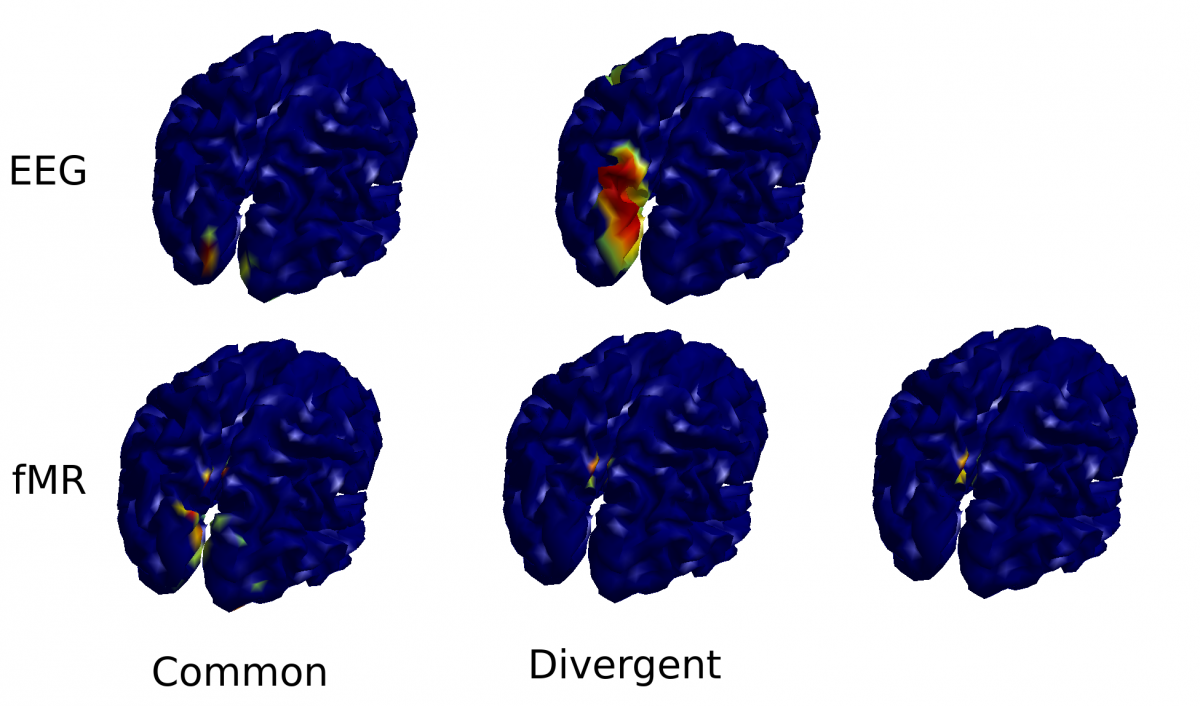
Project Summary: Scalp EEG signals are direct measure of brain electric activity by reflecting the postsynaptic cortical currents generated by the large pyramidal neurons which are located perpendicularly to the cortical surface. Functional MR imaging (fMRI) is the other way of measuring brain functions reflecting the oxygen metabolism of the brain. Temporal resolution of BOLD (blood-level-oxygen-dependent) signal measured with fMRI is confined to the time course of slow evolving hemodynamic activity (~ 10 s) while exhibiting high spatial resolution in terms of millimeters. Despite its low spatial resolution, scalp EEG measures brain function with a temporal resolution in terms of miliseconds. By compromising different imaging modalities, fusion of EEG and fMRI on a common space and time scale is one of the current problem of neuroimaging to reveal the complex dynamics of brain function and neuronal interactions. In this study, a novel EEG-fMRI fusion approach based on multilinear methods will be developed and applied to clinical and neurophysiological data. In this way, different platforms representing brain activity data will be integrated on the same spatial and temporal scales. Proposed approach will contribute to studies on brain functions and representation of memory, attention, information processing mechanisms in the brain. Proposed approach has a wide aplication area from diagnosis of neurological diseases to brain-computer interface studies.
Keywords: EEG-fMRI fusion, multilinear methods, parallel factor analysis, inverse problem, penalized regression
Funded by Bogazici University Scientific Research Project Council (2012 – 2014)
